JavaScript Execution Model: From Execution Context to Event Loop
JavaScript Execution Model Explained
Have you ever wondered how JavaScript actually runs your code? It’s not just about syntax; it’s about the Execution Model—the engine's internal process for parsing, planning, and executing your scripts.
This model is the backbone of JavaScript, and understanding it is crucial for mastering the language. It revolves around three core components:
- Execution Context
- Call Stack
- Event Loop & Queues
Let’s break these down into simple, actionable concepts.
1. Execution Context: Where Code Runs
Think of the Execution Context as the environment where your code lives and executes. It’s responsible for handling:
- Variable scope
- Function references
- The value of
this
Types of Execution Context
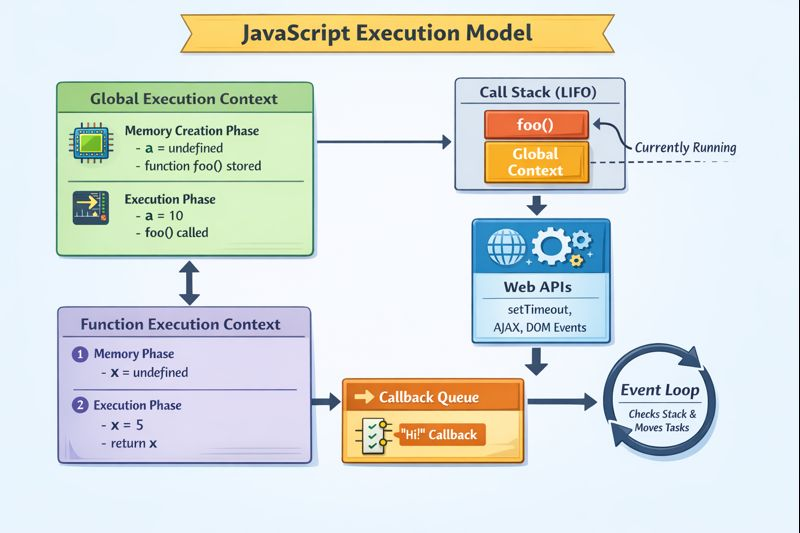
- Global Execution Context (GEC): The default context. It runs when your script loads. In the browser,
thispoints to thewindowobject. - Function Execution Context (FEC): Created whenever a function is called. It manages the function's own variables and arguments.
- Eval Execution Context: (Rarely used) For code running inside
eval().
The Two Phases of Execution
Before running a single line of code, the JavaScript engine performs a setup ritual:
Phase 1: Memory Creation Phase
- Memory is allocated for all variables (initially set to
undefined) and functions. - This is where Hoisting happens.
Phase 2: Execution Phase
- The code is executed line-by-line.
- Variables are assigned their actual values.
- Functions are invoked.
2. Call Stack: The Order of Execution
JavaScript is single-threaded, meaning it can only do one thing at a time. The Call Stack is the mechanism that keeps track of this.
It follows the LIFO (Last-In, First-Out) principle:
- When a function is called, it’s pushed onto the stack.
- When it finishes, it’s popped off the stack.
This simple structure ensures that the engine always knows which function is currently running and which one to return to.
Example Flow:
main() calls first(), which calls second().
- Stack Top:
second()(Running) - Middle:
first()(Paused) - Bottom:
main()(Paused)
3. Event Loop: Making JavaScript Responsive
If JavaScript is single-threaded, how does it handle asynchronous tasks like fetching data or timers without freezing the screen?
Enter the Event Loop mechanism.
The Big Picture
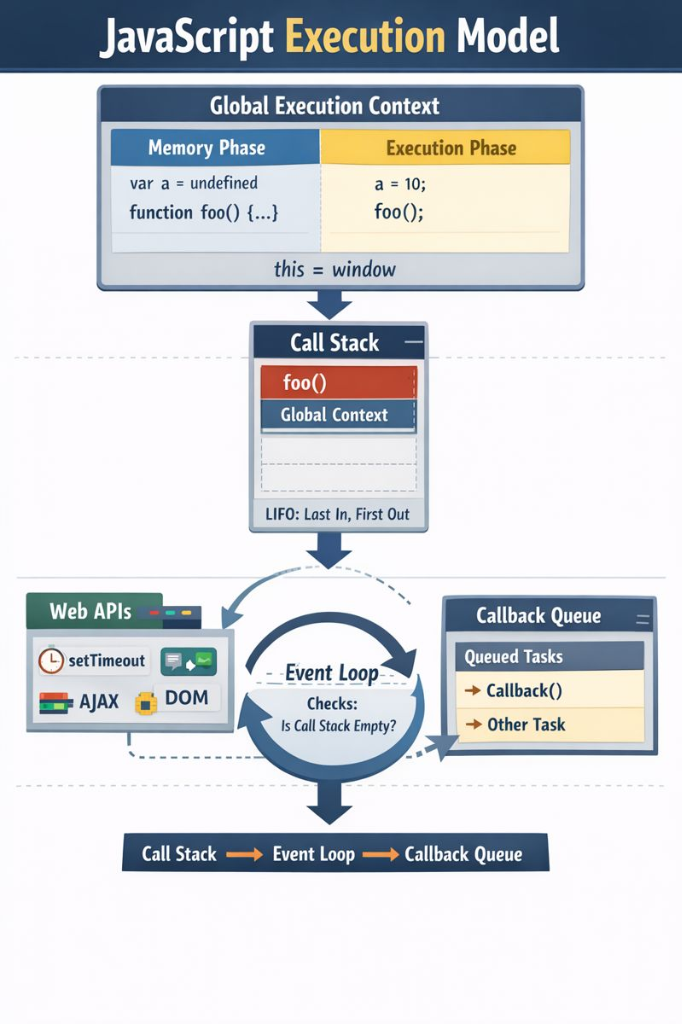
The runtime environment consists of:
- Call Stack: Runs synchronous code.
- Web APIs: Handles async operations (timings, fetch requests, DOM events).
- Queues (Callback/Task Queue): Holds callbacks ready to run.
- Event Loop: The coordinator.
How It Works
- Sync Code: Runs immediately on the Call Stack.
- Async Code: Delegated to Web APIs. The stack continues with the next task.
- Queueing: Once the async task finishes (e.g., timer ends), its callback moves to the Queue.
- The Loop: The Event Loop constantly checks: Is the Call Stack empty?
- If YES: It moves the first item from the Queue to the Stack.
- If NO: It waits.
The "Restaurant" Analogy
Imagine a restaurant kitchen:
- Chef (JS Engine): Can only cook one dish at a time.
- Cooking Station (Call Stack): The current task.
- Helpers (Web APIs): Chop veggies, pre-heat ovens (async work).
- Order Queue: Finished prep work waiting for the Chef.
- Manager (Event Loop): Ensures the Chef only takes a new order when the current dish is done.
Crucial Rule: The Event Loop will never push a queue task to the stack until the stack is completely empty.
4. Microtasks vs. Macrotasks
Not all async tasks are equal. JavaScript prioritizes them differently:
- Microtasks: High priority. Includes
Promise.then(),queueMicrotask,MutationObserver. - Macrotasks: Normal priority. Includes
setTimeout,setInterval,setImmediate.
Execution Order:
- Run all synchronous code.
- Run ALL Microtasks in the queue (until empty).
- Run ONE Macrotask.
- Repeat.
This is why a Promise usually resolves before a setTimeout, even if both are ready at the same time.
Summary
- Execution Context prepares the memory and environment.
- Call Stack manages the synchronous function order.
- Web APIs handle the heavy lifting for async tasks.
- Event Loop orchestrates everything, ensuring standard callbacks and microtasks run at the right time.
Understanding this flow allows you to write optimized, bug-free, and non-blocking JavaScript content.
References
Connect with Me
If you found this guide helpful, let's connect! I share more about web development and system architecture on my socials.